🖤 The Black Denarius – The Emperor’s Coin of Eternal Night
⏳ Estimated reading time: 12 minutes
The Black Denarius – The Emperor’s Coin of Eternal Night
They said Nero could make even the sun obey him—until he forged a coin that swallowed its light.
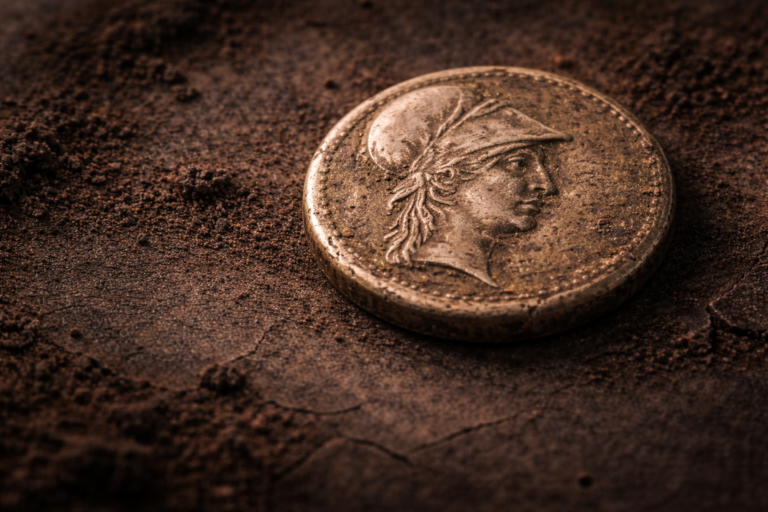
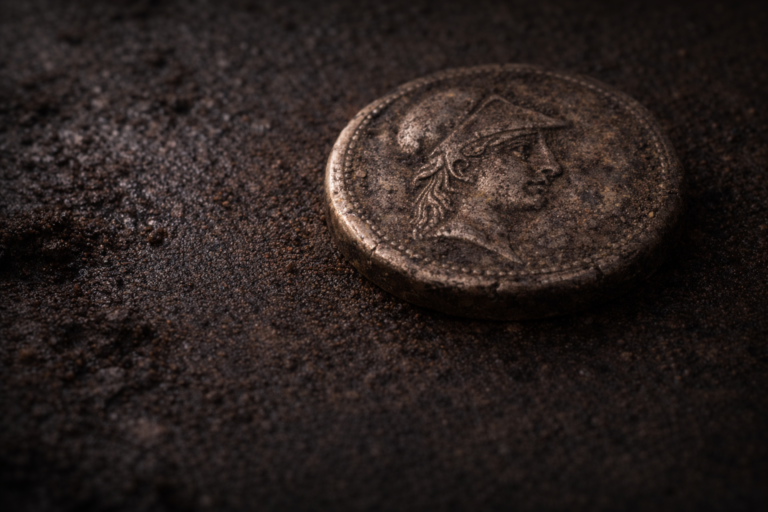
In the ruins of an imperial foundry beneath the Palatine Hill, archaeologists uncovered a vault sealed in volcanic ash. Inside, among charred molds and melted crucibles, lay a cluster of coins unlike any known Roman issue—silver so dark it seemed to drink the air around it. When first exposed to daylight, the pieces shimmered briefly before dulling again, as if rejecting illumination.
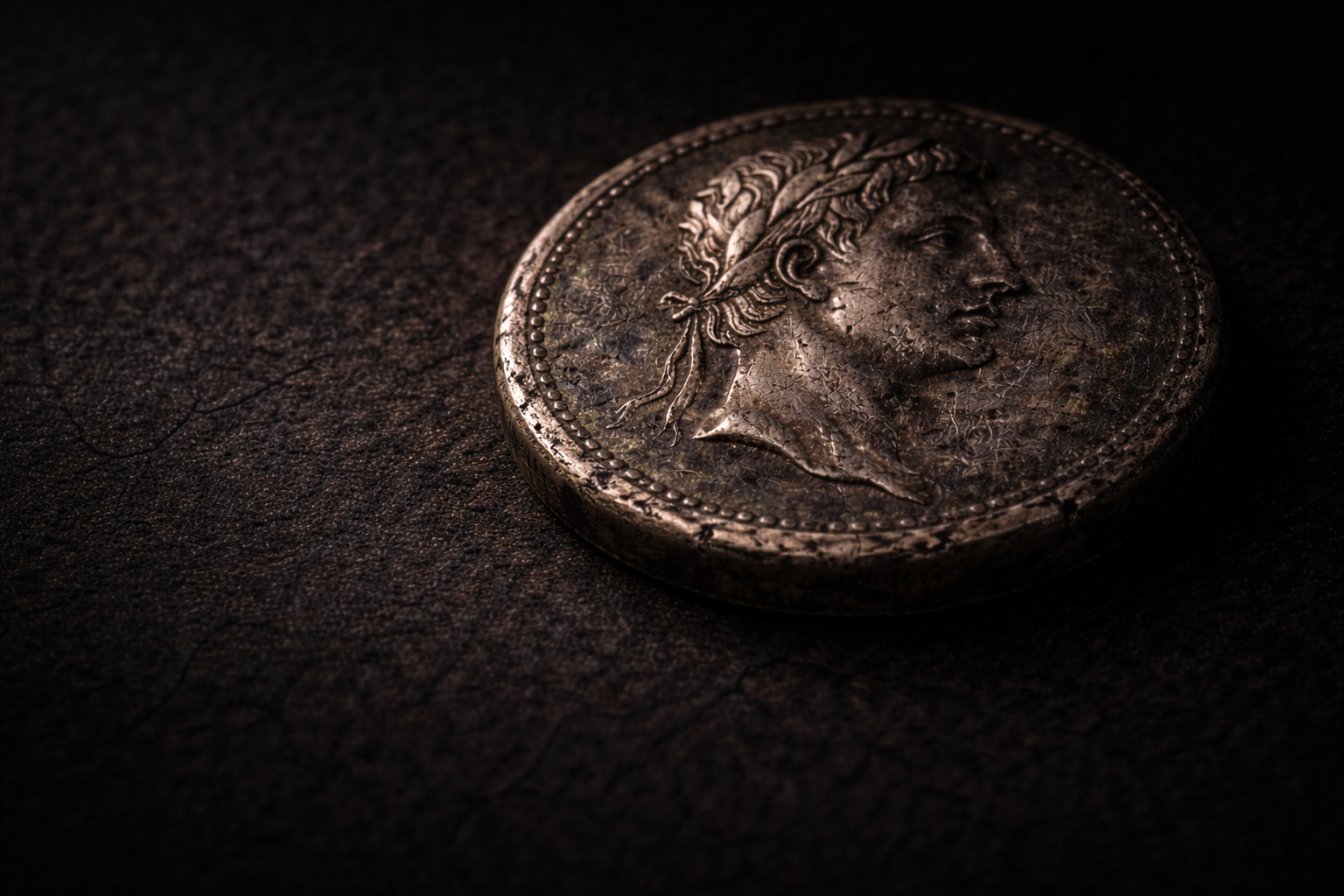
The lead researcher, Dr. Lucia Verano, described them as “metal that remembers fire.” One coin in particular drew her attention—a denarius bearing the image of Emperor Nero not crowned by laurels, but by a halo of flame. Around the edge ran an inscription never recorded in any mint record: “Lux mea extinguitur.” — “My light is extinguished.”
🔥 The Emperor’s Final Mint
Historical texts claim that near the end of his reign, Nero ordered a secret series of coins struck during the nights following the Great Fire of Rome. Witnesses wrote that he had grown paranoid, believing the gods themselves were conspiring to blot out his name. He commanded his smiths to forge denarii that could “outlast the sun,” mixing molten silver with volcanic glass and a powder imported from Egypt—believed to come from the tombs of pharaohs.
Only a handful were ever completed before the mint collapsed in an explosion that burned through its foundations. Survivors reported a blinding flash followed by complete darkness that lingered for hours. The Emperor’s last command, they said, was to seal the foundry forever, “lest the night escape.”
⚱️ The Coin’s Resurrection
The coin remained hidden for nearly two thousand years until Dr. Verano’s team unearthed it in 1985. She described a strange sensation upon touching it—“a pulse, faint but rhythmic, like a heartbeat under stone.” Over the following weeks, she began to notice that the lab’s lights dimmed slightly whenever the denarius was removed from its containment box. Colleagues dismissed it as coincidence—until one morning, the glass skylight above the excavation tent shattered inward without a sound.
Fragments of obsidian fell onto the table, spelling out a single Latin word: “Tenebrae.” — “Darkness.”
🕯️ The Experiment in Light
Intrigued, Verano arranged a controlled test. She placed the Black Denarius beneath a beam of concentrated light for eight hours. At the end of the experiment, the silver had turned jet black, and the bulb had burned out—its filament intact, but coated in soot. The coin remained cool to the touch.
That night, she recorded in her journal: “The reflection in the denarius is not mine.”
Over the following days, her team reported seeing faint silhouettes in their peripheral vision—figures wearing togas, faces hidden, walking through the camp after sunset. One worker claimed he saw Emperor Nero himself standing by the trench, his eyes burning “like embers under glass.”
🌑 The Mirror of Nero
Three weeks later, Verano vanished during a solar eclipse. Her tent was found empty except for her field journal, open to a sketch of the denarius surrounded by concentric circles labeled “rings of reflection.” The coin was gone. But in the ash outside her tent, a perfect imprint of the coin remained—negative, cold, and black as iron.
Historians have since drawn eerie parallels between the legend of the Black Denarius and other cursed coins such as The Ferryman’s Obol and The Oracle Drachma. Each shares a theme of reflection and transgression—the belief that coins could preserve fragments of divine or imperial power. Yet none seem to devour light itself like Nero’s final issue.
Part 2 will explore the modern rediscovery of the Black Denarius, its unnatural properties under spectral analysis, and the fate of those who tried to restore its shine—plus the Reality Check and Final Thought sections.
🌘 The Spectral Analysis
In 2007, an Italian research institute specializing in metallurgical preservation conducted a series of non-invasive scans on what was believed to be the Black Denarius. The coin had resurfaced anonymously through a private collection in Milan. Under visible light it appeared matte and opaque, but when examined under infrared spectroscopy, the surface emitted faint traces of ultraviolet radiation—reversed in frequency, as if absorbing visible wavelengths and re-emitting darkness.
Scientists noted an impossible property: every photograph taken of the coin came out inverted—black became white, light became void. Attempts to polish it only deepened the shade, as though the metal rejected purification. One technician described hearing “a sound like whispering ash” each time he wiped the surface.
Three days into testing, the lab suffered a total blackout. When power was restored, the coin was missing, and all digital records related to the project were irreversibly corrupted. The final log entry contained only one line of metadata: “lux_off().”
🔥 The Last Eclipse
Months later, a security camera in Naples captured footage of a man leaving a museum at dawn. In his hand glimmered a small dark object. Moments after he stepped into the sunlight, the frame flared white and the feed cut out. The camera lens had melted. Investigators found a coin-shaped burn on the pavement, etched in the same dimensions as a Roman denarius. The man was never identified.
Since then, the Black Denarius has passed into whispered rumor. Some believe it lies sealed within the Vatican’s forbidden archives, others say it rests deep in Vesuvius’s lava tubes—still glowing faintly beneath layers of ash. But for every theory, there is one recurring detail: during eclipses, certain observers report a momentary flicker across the sun’s edge, like a coin rolling through the sky.
🕯️ The Emperor’s Reflection
Historians now see the Black Denarius as more than a myth—it is Nero’s confession cast in metal. He who burned Rome sought to forge a currency that could buy forgiveness from darkness itself. But like all tyrants who tried to trap the divine, he created only a mirror that reflected his own ruin.
As one ancient scribe wrote in the Annales Tenebris: “The emperor’s light did not fade—it was devoured.”
Perhaps the coin never truly vanished. Perhaps it simply waits in the dark, as it always has, turning slowly in the ashes of empire, drinking the last light of every age.
💀 Reality Check
No historical record officially confirms the existence of a “Black Denarius,” yet several Roman denarii minted under Nero show signs of metallurgical experimentation involving darkened silver alloys. Roman chroniclers did describe nighttime minting rituals following the Great Fire of 64 AD, when the emperor allegedly sought to consecrate new coins “against divine wrath.” The concept of metal absorbing spiritual energy was present in ancient Roman myths, where cursed relics were said to hold divine reflection. The Black Denarius legend likely evolved as a cautionary tale against hubris—the belief that even emperors could master light itself.
💭 Final Thought
Every empire mints its own darkness. The Black Denarius reminds us that power without humility consumes itself, leaving behind only relics that reflect the void. Perhaps the true curse of Nero’s coin was not that it absorbed light—but that it made humanity see how easily it can disappear.
🔗 Explore more ancient coin legends on the HistoraCoin YouTube Channel
Read also: The Ferryman’s Obol, The Oracle Drachma, and The Phantom Aureus.