The Coin of Shadows — The Forgotten Currency of the Dead
⏳ Estimated reading time: 11 minutes
The Coin of Shadows — The Forgotten Currency of the Dead
In the silence beneath the earth, even the dead remember how to pay.
In the winter of 1931, a team of archaeologists exploring the catacombs of Syracuse uncovered a sealed chamber hidden behind centuries of dust and limestone. The air was heavy and dry, carrying the scent of something long forgotten. Inside the chamber lay no bodies—only footprints burned into the stone and a single coin resting upon a slab of obsidian.
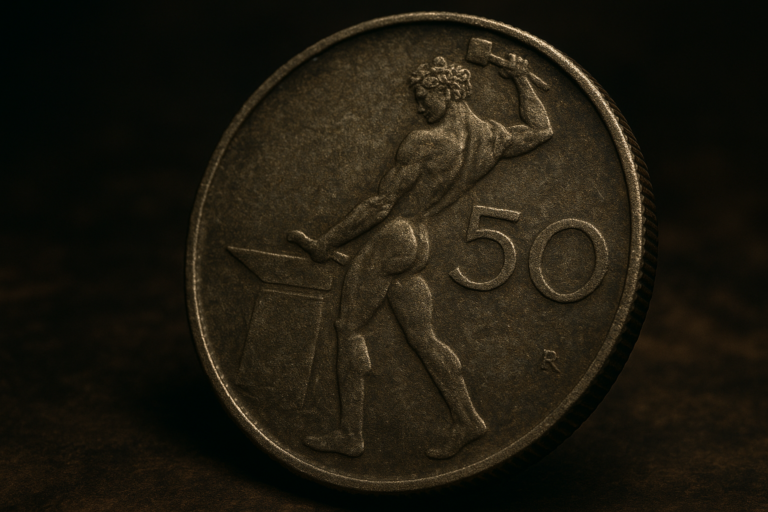
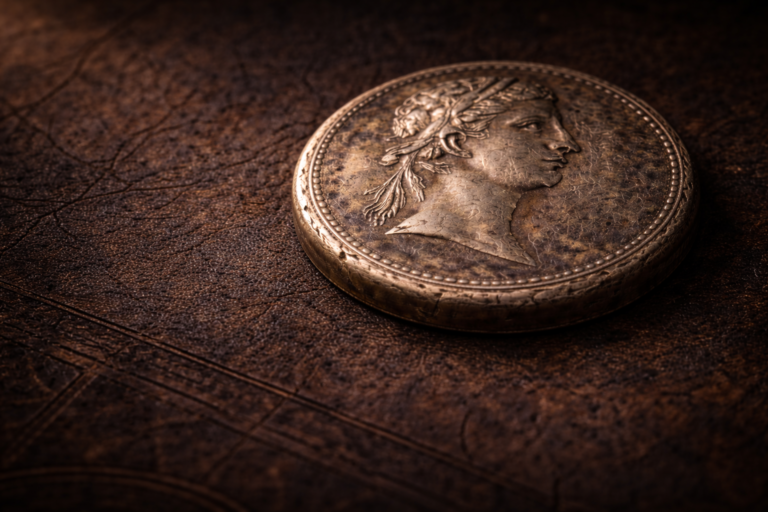
It was small, perfectly circular, and darker than bronze or iron—its surface absorbed the lamplight instead of reflecting it. One side bore the faint image of a hooded figure offering a coin to a faceless man. The other was blank, as though time itself had refused to touch it.
⚰️ The Catacomb Discovery
The artifact was catalogued under the name “Nummus Umbrae”—the Coin of Shadows. Researchers believed it to be a symbolic offering to the dead, perhaps a funerary token for souls traveling the underworld. But the excavation records noted something strange: the chamber where the coin was found was colder than any surrounding tunnel, and their lamps dimmed whenever they approached it.
When the coin was lifted from the altar, the temperature in the chamber dropped instantly. One worker collapsed, claiming he had heard “footsteps behind the walls.” Another swore he saw faint silhouettes moving in the stone, like figures trapped behind glass.
The team sealed the chamber and brought the coin to Palermo for study—but it never reached the museum. The train carrying the artifacts derailed outside Enna. All cargo was recovered except one box, marked with a black sigil: the symbol of the underworld god Hades.
🪙 The Collector and the Curse
Months later, a private collector named Anton Rinaldi announced he had acquired a “shadow coin” of Greek origin. His letters describe its unsettling nature: “It grows heavier at night,” he wrote. “And when placed in darkness, I hear whispering in the metal—soft, pleading, endless.”
Rinaldi hosted a small gathering to display the piece, inviting historians and spiritualists. When the lights were dimmed for demonstration, the room filled with a faint scent of smoke. Witnesses reported that the coin began to emit a cold mist that gathered at the edges of the table, forming the outline of a human face.
The guests fled in terror. When police arrived hours later, the collector was missing, and the coin lay on the floor beside an overturned chair. The only clue was a handprint scorched into the wood—fingers stretched toward the door.
🌑 The Currency of the Dead
Local folklore soon revived an ancient belief: that some coins were never meant to be spent among the living. According to an obscure Greek funerary hymn, there existed a hidden river beneath the Styx, called Lethe Nyx—the “Shadow Flow.” The souls who refused to forget their lives could not cross it, so they minted their own currency: coins forged from memory and grief.
These coins, it was said, would sometimes rise to the surface world, carried by dreams or chance discoveries—each one calling for a master to return it to the dark.
Part 2 will reveal what happened when the Coin of Shadows resurfaced in the modern era, and the terrifying experiment that attempted to weigh a soul—along with the Reality Check and Final Thought sections.
🌒 The Experiment of Palermo
In 1964, the Coin of Shadows appeared once again—this time within the archives of the University of Palermo. A graduate researcher named Elisabetta Morelli found the coin sealed inside a mislabeled crate. Against protocol, she began to study it alone, using spectral imaging to measure its reflectivity. The results were inconclusive, but she noted something extraordinary: the coin’s shadow appeared to move independently of the light source.
She described it as “a dark ripple, like smoke behind glass.” Every time she turned off the lamp, she felt as though something in the room exhaled. Determined to continue, she placed the coin on a balance scale beside a matching bronze piece. The bronze coin weighed 9 grams. The shadow coin, 8.9 grams—until the lights went out. When she relit the room, the scale was level.
“The coin feeds on absence,” she wrote. “It hungers for what leaves the body when the heart stops.”
That night, the security guard reported hearing whispers in the lab and the sound of coins falling to the floor. When he entered, the room was empty—except for the scale, now tipped heavily to one side. Elisabetta’s coat remained on the chair. She was never seen again.
⚫ The Shadow’s Return
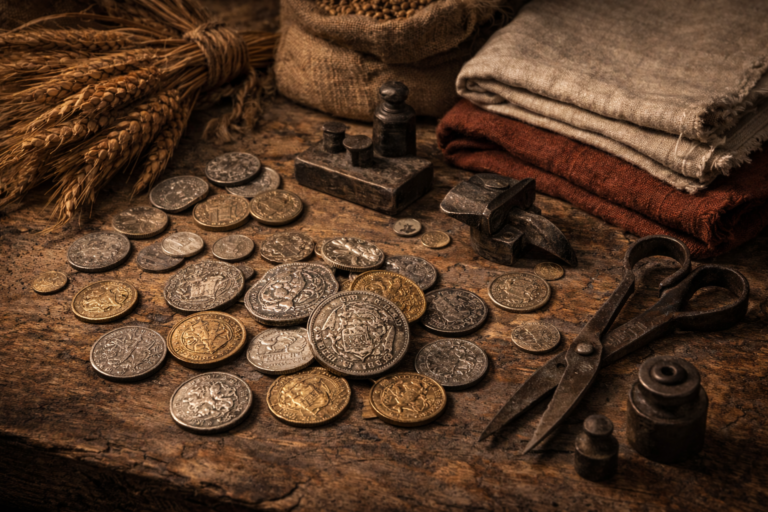
In the decades that followed, sightings of the Coin of Shadows spread across Europe. Museum curators spoke of unmarked donations arriving in black envelopes, containing a single coin wrapped in linen. Each coin was darker than the last. Those who attempted to polish them reported chills, nausea, and the faint sound of breathing behind them.
In 2011, a photographer captured an image of a coin identical to Rinaldi’s during an excavation near Thessaloniki. When developed, the photograph showed a faint reflection—a blurred human silhouette staring back from the coin’s surface.
Experts compared it with earlier cases such as The Ferryman’s Obol and The Oracle Drachma, noting a shared theme: the boundary between the living and the dead marked by currency. Yet the Coin of Shadows seemed unique—it didn’t pay passage; it collected debt.
🕯️ The Last Transaction
In 2020, an anonymous online collector claimed to own the “final coin.” He posted a single photograph showing a black disc on his palm. The caption read: “It feels warm. It keeps whispering my name.”
Within days, his account vanished. The post remains archived, but the metadata reveals the photo’s timestamp was taken one minute after his declared time of death, according to local police records. The coin has not been traced since.
Legends now say that the Coin of Shadows circulates endlessly—passed hand to hand, unseen, balancing the debts of both worlds. And those who find it will never again see their own reflection.
💀 Reality Check
While there is no verified record of a “Coin of Shadows,” ancient Greek and Roman burial sites often contained coins known as Charon’s obols—offerings to pay for safe passage across the underworld rivers. Some coins recovered from catacombs do show extreme black patination, caused by sulphuric gases reacting with copper and silver over centuries. The myth of the “shadow coin” likely emerged from such discoveries, blending natural corrosion with ritual fear. Still, several documented accounts mention unexplained cold spots and electrical interference near sealed tombs where metallic offerings remain untouched—a reminder that myths often cling to the edges of truth.
💭 Final Thought
Every coin tells a story of exchange—value for value, life for memory. The Coin of Shadows asks a darker question: what if the dead never stopped trading? Perhaps each coin we find in the earth is not an artifact, but an unpaid debt, still waiting for someone to collect.
🔗 Watch more mysterious coin legends on the HistoraCoin YouTube Channel
Read also: The Ferryman’s Obol, The Black Denarius, and The Oracle Drachma.